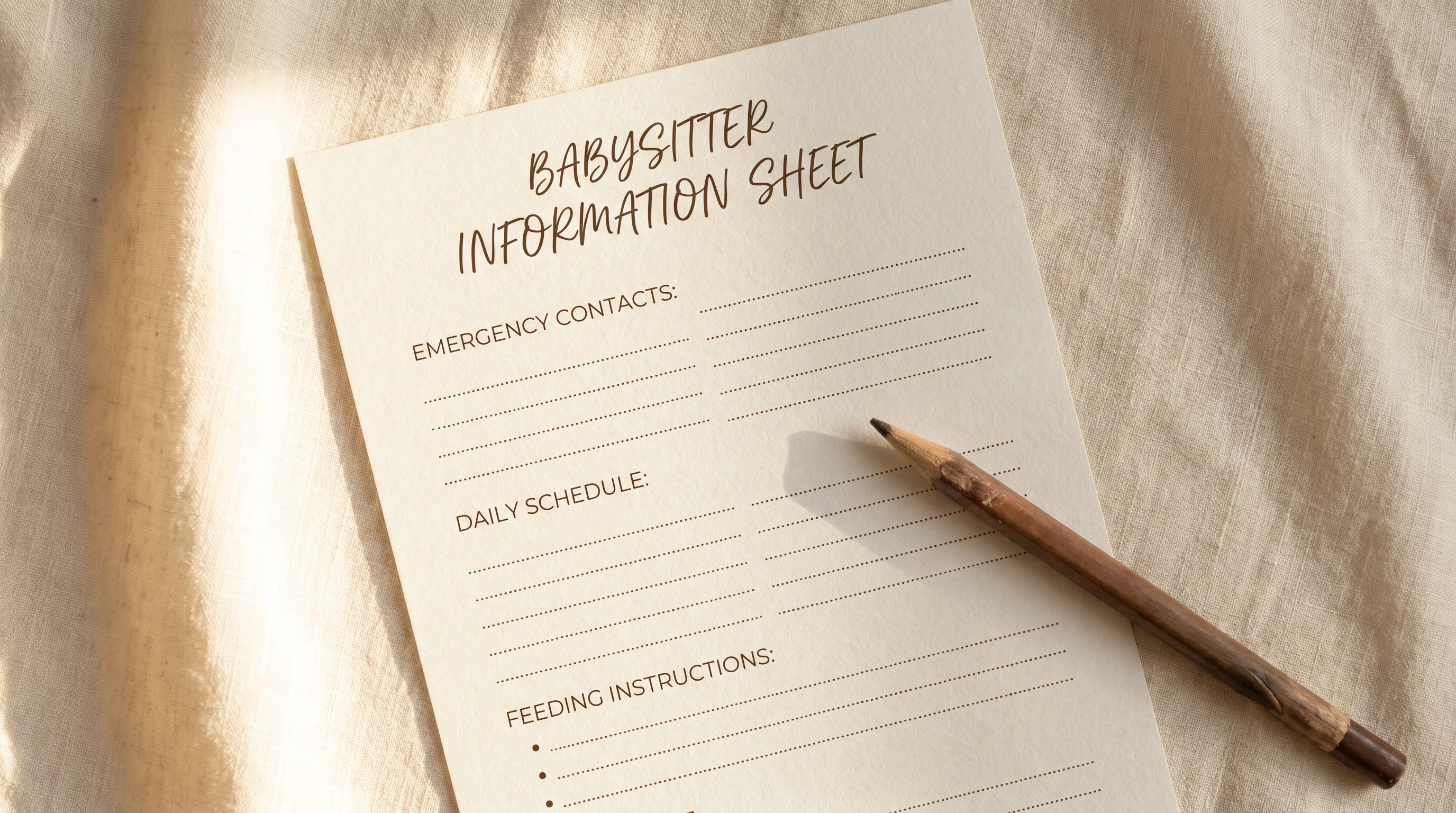
A babysitter info sheet is a single document — one or two pages — that gives your caregiver everything they need before you walk out the door. Emergency contacts, your children's names and ages, medical notes, the daily schedule, feeding instructions, bedtime routine, and house rules. All of it, in one place, readable in under two minutes.
Most parents wing it. They give a verbal rundown at the door, mention the important things, and hope the babysitter remembers. Then they're twenty minutes into dinner when they get a text asking for the pediatrician's number.
A good babysitter info sheet eliminates that. The caregiver has what they need, and you leave without the mental load of wondering what you forgot to say.
What a babysitter info sheet actually is
It's a reference document for the visit. Not a manual — a reference. The goal is that your babysitter can answer any reasonable question about the evening without calling you.
It's different from a family emergency binder. The binder holds permanent household information: insurance, medical history, legal document copies. The babysitter info sheet covers what's specific to this visit and this household right now — today's schedule, current routines, active medications. The two serve different purposes and both belong in a well-organized caregiver system.
According to the American Academy of Pediatrics, caregivers should have written instructions for infant sleep, feeding, and emergency contacts before being left alone with a baby. A babysitter info sheet is the practical way to deliver all of that in one document.
What to include on a babysitter info sheet
Eight sections cover most households. Put them in this order, because it's the order a caregiver is most likely to need them:
Emergency contacts
Your mobile number first. A second parent or co-parent. A neighbor or nearby family member who can be physically present within ten minutes. Your pediatrician's number, including the after-hours line. And 911 at the top, written out — don't assume people remember to call it first.
Three contacts is the minimum. Four is better. Include names, not just numbers, so the babysitter knows who they're calling.
Child information
Full name, date of birth, and current age for each child. Allergies — food, medication, environmental — with severity noted. Any current medications, with dosage and timing. Your pediatrician's name. Nothing more complicated than that. Write it for someone who has never met your child.
Daily schedule
The time you're leaving and when you expect to return. Meal times and snack times. Nap schedule if applicable. Any activities or commitments during the visit. Write it as a timeline — 5:00pm, 5:30pm, 6:00pm — not as prose. A babysitter scanning for what to do next doesn't want to read a paragraph.
Feeding and meals
What the children can eat and what's off-limits. Where food is in the kitchen. Any preparation notes. For toddlers and younger children, portion sizes and what to do if they refuse to eat. For infants, feeding instructions belong in their own section — see below.
Bedtime routine
Start time, steps in order, and anything that matters to the child. A specific stuffed animal. A song. Whether they need the door open or closed. Whether a nightlight is on. Three minutes of specific detail here prevents thirty minutes of phone calls later.
Behavior and house rules
Screen time limits. What the children are and aren't allowed to do. How you handle tantrums or resistance, if there's a consistent approach. What to do if a child won't go to bed. Keep this short — a few rules, not a philosophy.
House information
Wi-Fi network and password. Where the first-aid kit is. Where spare diapers or wipes are kept if relevant. Any quirks about the house — a door that sticks, a smoke alarm that trips when cooking. The address of your home, written out, in case the babysitter needs to give it to emergency services and blanks.
Pets
If you have a pet, include feeding instructions and anything the caregiver needs to know about the animal's behavior around children or strangers. If the pet is crated at night, say so.
Babysitter info sheet for an infant
An infant babysitter information sheet needs more specificity than one written for older children. Infants can't communicate, routines shift weekly, and there is less room for a caregiver to improvise.
Feeding
Whether breastfed or formula-fed. If breastfed, how many ounces of expressed milk are in the fridge and where. If formula, the brand, the scoop-to-water ratio, and whether to warm it and to what temperature. Feeding frequency and the last time the infant ate. Burping method that works for this baby.
Sleep
Wake windows — how long the baby can typically be awake before needing sleep. Sleep cues to watch for. How you put the baby down. The safe sleep setup: firm flat surface, no loose bedding, no positioners, on their back. Whether a white noise machine is used and where it is.
Soothing
What works when the baby won't settle. A pacifier and where it is. A particular hold. A specific motion. Whether they respond to being worn. Don't leave this to improvisation — a babysitter with a crying infant and no guidance is in a stressful situation that a few sentences on a sheet can prevent.
Diaper and care notes
Diaper brand and size. Wipe brand if the baby has sensitive skin. Any current diaper rash and what's being used to treat it. Anything the caregiver should watch for and contact you about — a rash, an unusual feeding pattern, signs of illness.
How to format a babysitter info sheet
One or two pages maximum. If it's longer than that, most of it won't get read.
Use section headers so the caregiver can scan to what they need. Don't write in paragraphs — use short lines and simple phrases. The reader isn't sitting down with a coffee. They're trying to find a phone number while managing children.
Print it. A digital version sent by text or email requires the caregiver to find it on their phone, which they may not be able to do quickly while managing children. A printed sheet on the kitchen counter is always accessible.
Use a standard font at a readable size — 11pt or larger. The person reading it may be doing so under low light or under stress. Readability is not a small detail.
Leave space to write in the date and any visit-specific notes. Some things change visit to visit — an earlier bedtime because of an early morning, a food that's being introduced, a behavioral note from the week. A sheet with a "Notes for tonight" section at the bottom is more useful than one that's entirely fixed.
What NOT to put on a babysitter info sheet
Passwords and financial information. If the sheet is left out and seen by someone it wasn't intended for, nothing on it should create a security problem. An address is unavoidable. Anything beyond that should be stored elsewhere.
Instructions the babysitter doesn't need to execute. If you want the dishwasher unloaded or the mail brought in, say that verbally or write a separate note. The info sheet is for child care — mixing in household tasks makes it harder to scan for what actually matters in an emergency.
Everything you know about your child. The info sheet is not a parenting document. The caregiver doesn't need your child's full medical history, their sleep regression timeline, or a detailed personality breakdown. What they need is what's relevant to tonight.
Keeping it current
For infants and young toddlers, routines change fast. A babysitter info sheet that was accurate three weeks ago may have a nap schedule, feeding frequency, or bedtime that no longer applies. Review it before each visit and update anything that's changed.
For school-age children with stable routines, a review every few months is usually enough. But update immediately after any of the following:
- A new allergy diagnosis or food introduction
- A medication change
- A new bedtime or routine shift
- A change in emergency contacts
- A move or change of address
Always print a fresh copy rather than handing over a sheet with handwritten corrections. Crossed-out information creates hesitation — a caregiver shouldn't have to wonder which version of a phone number is current.
Write the date it was last updated in the header. It takes two seconds and tells the babysitter immediately whether the information is current.