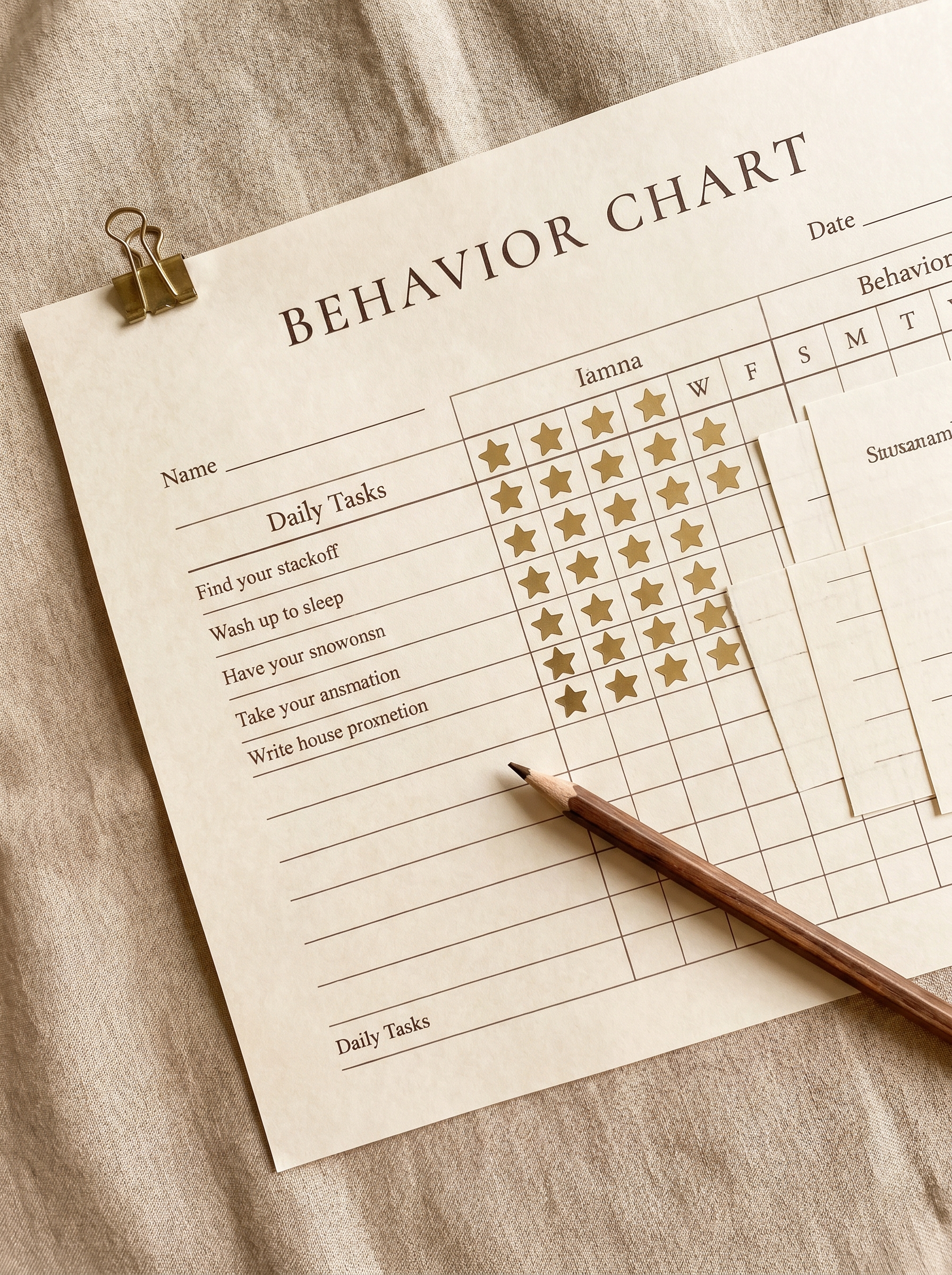
A behavior chart is a visual tracking system where children earn marks — stickers, checkmarks, or points — for completing specific behaviors. Used correctly, it gives kids a clear picture of what's expected and something concrete to work toward. Used incorrectly, it lasts about two weeks before ending up in a drawer.
The keyword here is "behavior chart for kids," but the more useful question is: what makes one actually work? This guide covers how to choose the right type for your child, how to set it up properly, and the one setup mistake that causes most charts to fail.
What behavior charts actually do
A behavior chart makes expectations visible. That's the core function.
For most children under 10, abstract instructions — "be good," "be responsible," "try harder" — don't land well. They need something concrete: a box to fill, a sticker to earn, a visual record they can see and point to. The chart converts a vague expectation into a trackable target.
Charts don't change behavior on their own. They create a structure that supports the behavior you're trying to build. The follow-through — the consistent check-ins, the calm responses to misses, the actual delivery of rewards — is what does the work. The chart is the scaffold. You're still the builder.
The American Academy of Pediatrics recommends positive reinforcement systems for children aged 4–12 as a component of broader behavioral support — alongside consistent routines and clear, calm communication.
When they work — and when they don't
Behavior charts work when:
- The behavior is specific. "Get dressed before 7:30 am" is trackable. "Have a good attitude" is not.
- The child understands the chart. They know what earns a mark, what the reward is, and when they'll get it — before the chart starts.
- The parent is consistent. A missed mark that goes unrecorded teaches the child the chart doesn't actually matter.
- The reward is meaningful to the child. Not to you.
They don't work when:
- The chart tracks more than 5–6 behaviors at once
- The reward is too far away — more than a week for children under 8
- The parent only checks the chart when there's a problem
- The behaviors on the chart change before the child has had a chance to succeed
If your child has a diagnosis like ADHD or sensory processing differences, a standard sticker chart often won't work. The systems that work best for neurodiverse children are built differently — shorter reward cycles, more visual structure, fewer behaviors tracked at once. A generic chart applied to a child who needs a different approach isn't a chart problem. It's a fit problem.
The three types of behavior charts
1. Sticker chart
The simplest format. A grid where the child earns one sticker per completed behavior. When the grid is full — or a row is complete — they earn a reward. Works well for ages 4–7. Easy to explain, easy to maintain, and visually satisfying for younger children.
2. Point chart (token economy)
The child earns points instead of stickers. Points accumulate and can be "spent" on different reward tiers — a small reward at 10 points, a bigger one at 30. More flexible than a sticker chart, and better suited to ages 7–12. Requires slightly more administration but lasts longer because reward values can be adjusted as the child grows.
3. Visual schedule or routine chart
Not strictly a behavior chart — more of a sequence reminder. It shows what needs to happen in order: wake up, get dressed, brush teeth, eat breakfast. Works well for children who struggle with transitions or need visual structure to move through a routine independently. Particularly useful for ADHD and anxiety.
Most printable behavior charts are sticker-chart style. A well-designed point chart takes more setup but tends to last longer because the system can grow with the child.
Choosing by age
| Age | Best chart type | Notes |
|---|---|---|
| 3–4 | Visual schedule | Abstract rewards don't land yet. Focus on routine, not rewards. |
| 4–7 | Sticker chart | Keep to 3 behaviors max. Daily or every-other-day reward. |
| 7–10 | Sticker or point chart | Can handle weekly rewards. Add responsibility behaviors. |
| 10–12 | Point chart | More autonomy. Let them help choose the reward tiers. |
| 12+ | Behavior charts rarely work as designed | Natural consequences and direct conversation work better at this age. |
Setting it up: the part most parents skip
Most parents put the chart on the fridge and expect it to run itself. It doesn't.
The setup conversation is more important than the chart design. Before the chart goes up, sit down with your child and cover three things:
- What behaviors are on the chart, and why. Use plain language. "Getting dressed before 7:30 helps mornings feel less rushed for everyone."
- Exactly what earns a mark. Be specific. "You get a sticker if you're dressed and downstairs before I call breakfast — not after."
- What the reward is, and when they'll get it. Show them on the chart where the reward triggers. Point to it. Make it real.
This conversation takes 10 minutes. Skipping it adds two weeks of renegotiation later.
The most common reason charts fail
Too many behaviors tracked at once.
A chart with 10 items isn't motivating — it's overwhelming. The child can't tell what's most important. They fail often enough in the first few days that the chart stops feeling winnable. Once it stops feeling winnable, it stops working.
Start with three behaviors. After two consistent weeks, add a fourth. The goal is for the child to end most days feeling like they succeeded.
A chart that gets filled 70% of the time is working. One that gets filled 100% of the time is probably too easy. One that gets filled less than 50% of the time needs to be simplified — not enforced harder.
The CDC's positive parenting resources note that praise combined with a tangible reward is more effective than either alone, particularly for children under 8. The chart is the structure. The moment of recognition — "you did it" — is what builds the habit.
If you're building a broader household system that covers behavior, chores, and routines in one place — especially for a child who benefits from visual structure and shorter reward cycles — our Neuro-Inclusive Chore & Reward System was designed with exactly that in mind. It includes a usage guide built around the principles above: fewer behaviors, clear expectations, short reward cycles.