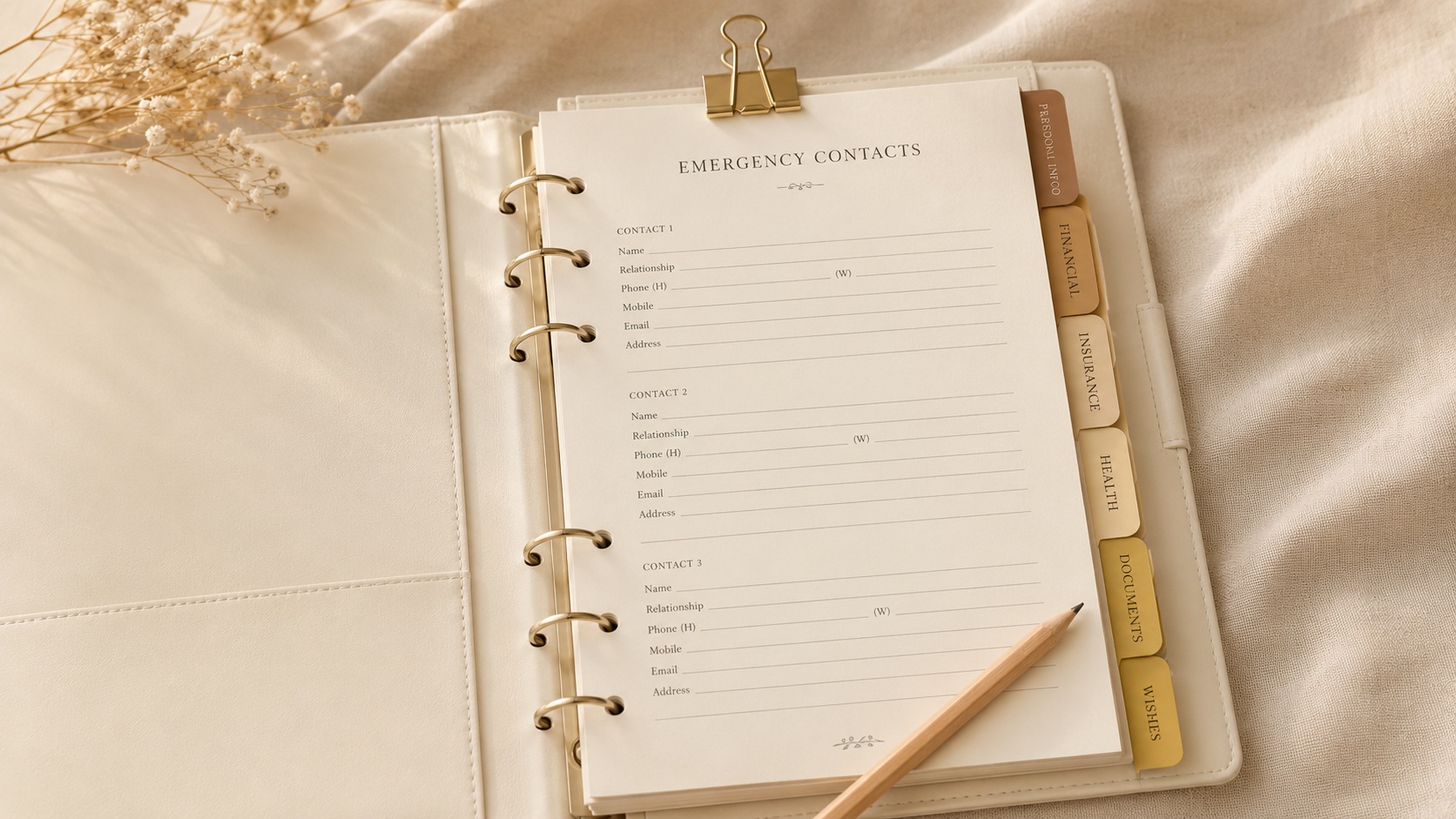
A family emergency binder is a single folder holding every contact, medical detail, and document your household needs during a crisis — or any time someone who isn't you needs to make a decision on your family's behalf. It's the ER nurse who needs your child's blood type at 2am. The babysitter who can't reach you and needs the pediatrician's number. The neighbor helping out after a fire.
Most families don't have one. Most build it after the moment they wish they had it. This guide covers what goes inside, how to structure it, and the two common mistakes that make binders useless when you actually need them.
What a family emergency binder actually is
It's a reference document, not a disaster kit. The kit has water, flashlights, and food. The binder has information — the kind that's hard to reconstruct from memory when you're stressed, away from home, or handing control to someone else.
At its core: emergency contacts, medical information for each family member, insurance details, and copies of the documents that are hardest to replace. The better ones also include a household contacts page and a one-page written emergency plan.
The standard is one binder per household, kept accessible to any adult who might care for your home or family. FEMA recommends a household emergency plan as a baseline for family preparedness — a binder gives that plan a permanent, findable home.
What goes inside a family emergency binder
Six sections cover most households. Start with these in order:
Emergency contacts
At least 3–4 people beyond 911. Your first contact when something goes wrong, a backup, someone who knows your children well, and someone who can handle logistics — picking up kids, waiting for a contractor, handling a situation you can't manage remotely. Include name, phone number, and relationship. Don't include people who won't answer.
Medical information
One sheet per family member. Full name, date of birth, blood type, allergies with severity noted, current medications with dosages, and your primary care doctor's name and direct number. Write it for a stranger. Don't use abbreviations only you would recognize.
Insurance information
Health, dental, home, and auto. Policy numbers and the claims phone number for each. The card numbers alone aren't enough — what a caregiver or ER intake desk needs is the provider contact and your member ID together.
Vital document copies
Photocopies only — not originals. Passports, driver's licenses, birth certificates, social security cards, and any relevant legal documents such as custody agreements or power of attorney. Originals belong in a fireproof safe or bank safe-deposit box.
Household contacts
Utility companies (gas, electric, water, internet), your landlord or mortgage servicer account number, HOA contact if applicable, and your home and auto insurance agents directly — not just the 1-800 line.
Emergency meeting plan
One page. Where your family goes if you can't return home, a backup meeting point if the first is unavailable, who calls whom, and which radio station covers local emergency broadcasts. If your children are old enough to read it, they should have their own copy.
How to organize it
Use tabbed dividers — one per section, labeled clearly enough that a stranger can navigate in under two minutes. That's the actual test. Give it to someone who's never seen it and time how long it takes to find your health insurance card. If it's more than 90 seconds, restructure.
Keep the first page simple. Home address. Three phone numbers. Nothing else. That's the page an ER nurse or a babysitter reaches for first. Fill it in before you fill in anything else.
If multiple people will use the binder — a nanny, a co-parent, a partner — color-code the sections. The visual shortcut helps when someone is moving quickly.
What NOT to include
Passwords and PINs don't belong in a paper binder. If the binder is lost or stolen, those are exposed. Keep login credentials in a password manager (Bitwarden, 1Password, or similar) and a separate encrypted note stored offline. The binder should contain no information that would be dangerous in a stranger's hands beyond your home address and names.
Lengthy instructions make the binder slow in an emergency. Write everything for 30-second scanning. One sentence per line where possible. No paragraphs in the contacts section.
How often to update it
Twice a year. Set a recurring calendar reminder for January and July. At each review, go through it section by section:
- Confirm all phone numbers are still active
- Check insurance card and ID expiry dates
- Update any medication or dosage changes
- Add any new household members, pets, or regular contacts
- Verify the emergency meeting plan still makes sense
Also update immediately after major changes: a new baby, a new diagnosis, a move, a new doctor, a change in insurance, or a custody arrangement update. Stale information is worse than no information — it creates false confidence.
Write the last-updated date on the inside cover. It takes two seconds and tells anyone who uses the binder how current the information is.
Using it with a babysitter or nanny
The binder should be visible and accessible to anyone you leave in charge. Not locked away. Put it in the kitchen drawer or on the shelf near the front door — somewhere with no ambiguity about where to look.
Walk any new caregiver through it on their first shift. Show them where it is, confirm the emergency contacts on the page know the caregiver might call, and note the caregiver's own number on the inside cover so someone else can reach them if needed.
The binder and a babysitter handoff sheet serve different purposes. The handoff sheet covers today: the schedule, meals, nap time, and today-specific instructions. The emergency binder covers everything that doesn't change week to week. Keep them separate and make sure your caregiver knows where both are.