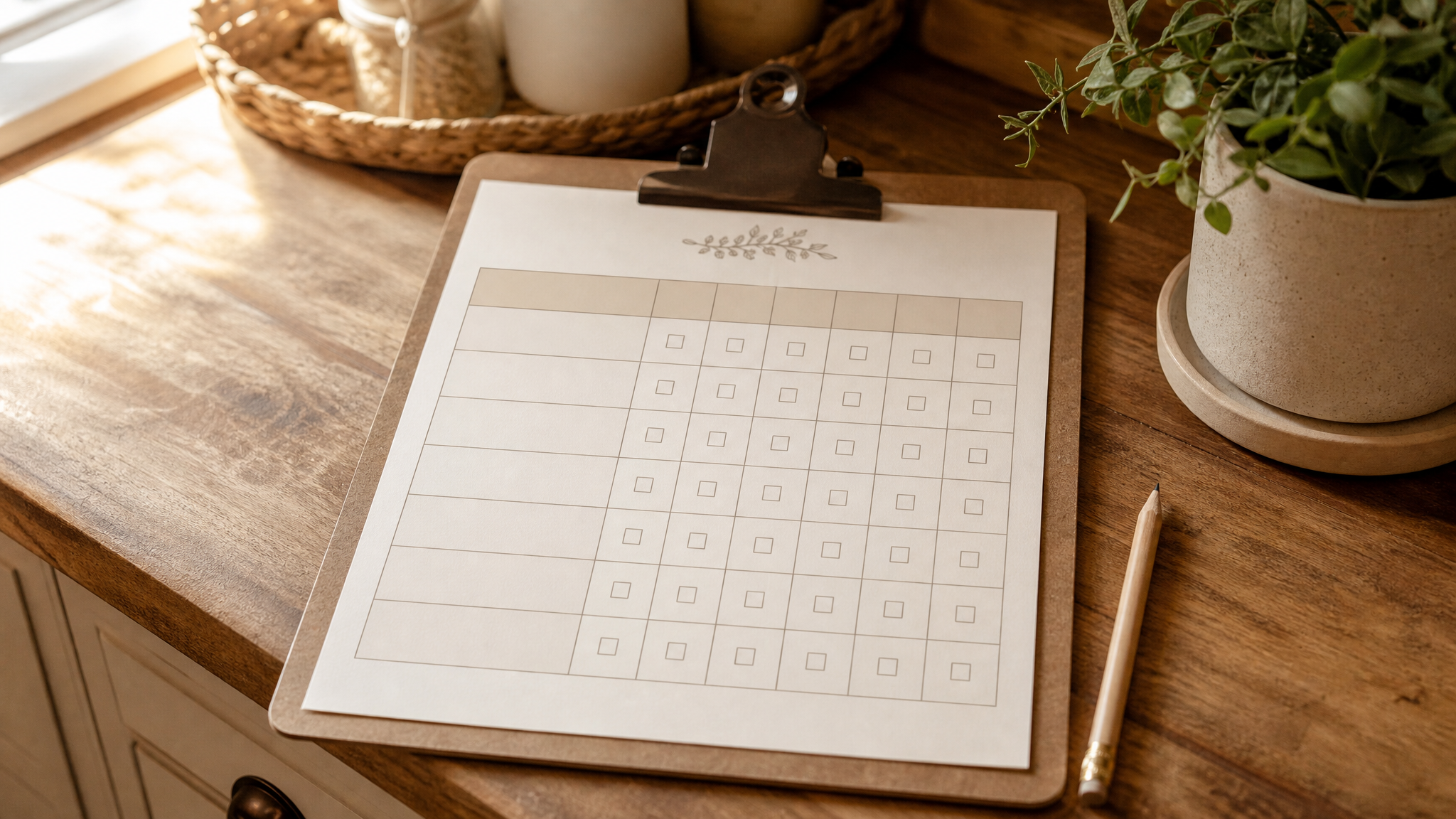
A printable chore chart template is only as useful as its fit with your household. The same weekly grid that works perfectly for one family gets printed once, ignored by day three, and quietly recycled in another — not because the chores were wrong, but because the format was.
Most parents download whichever template ranks first, without checking whether it matches the child's age, the number of kids sharing it, or how the week actually runs in that house. A chart built for a single child with five tasks doesn't scale to three kids with different chore loads. A grid designed for a 10 year old who can read confuses a 4 year old who needs pictures instead of words.
This guide covers the main template formats, what should actually appear on one, whether to share a chart across siblings, and how often to reset it — so the one you print survives longer than the first two weeks.
What "chore chart template" actually means
A template is a reusable structure — the same layout, printed or wiped clean, week after week. That's different from a one-off chore list, which is just the tasks written down for right now with no repeating format behind it.
The template decision matters because it determines how much friction exists every single week. A good template needs no redesign — you fill in names, check a few boxes if the tasks change, and it's ready. A poor one requires rebuilding from scratch each time, which is usually the point a chore system quietly stops.
The four main chore chart template formats
Nearly every printable chore chart falls into one of four structures. Each one solves a different problem, and picking the wrong one for your situation is the most common reason a chart gets abandoned.
| Format | Best for | Reset cadence | Main downside |
|---|---|---|---|
| Weekly grid | Kids 7+, multiple recurring tasks | Once a week | Too much structure for younger kids |
| Daily checklist | Kids under 7, a short set of daily basics | Reset every day | No visible week-over-week progress |
| Sticker / token chart | Kids 3–7, immediate visual feedback | Weekly or when full | Needs supplies (stickers, tokens) restocked |
| Laminated reusable | Any age, households that want zero reprinting | Wiped weekly with a marker | Marker ghosting over time; needs lamination upfront |
Weekly grid
A table with tasks down one side and days of the week across the top. This is the format most people picture when they think "chore chart." It works because it shows the whole week at a glance — a child (or parent) can see Tuesday's gap before it becomes a pattern. It's the wrong choice for a 4 year old, who doesn't yet have a working sense of "week" as a unit of time.
Daily checklist
A short, flat list of what needs doing today, with no reference to yesterday or tomorrow. This removes the tracking step entirely, which is exactly why it works better for younger children — there's nothing to interpret beyond "is this done right now."
Sticker or token chart
Same structure as a weekly grid, but completion is marked with a sticker or a small token instead of a checkbox. The physical act of placing something gives younger kids a stronger sense of progress than a checkmark does. The tradeoff is upkeep — someone has to keep stickers stocked and within reach.
Laminated reusable template
Any of the above, printed once and laminated, then filled in with a dry-erase or wet-erase marker. This is the lowest-effort long-term option for a household whose chore list doesn't change much — no reprinting, ever. The one real drawback is that dry-erase ink leaves faint ghosting after a few months, which is worth knowing before you commit to it as the only copy.
One shared chart, or one per child?
Share a single chart when siblings are close in age and their task lists are genuinely similar — one grid, one column per child, hung in a shared space. It saves paper and wall space, and it works fine as long as the workload actually is comparable.
Split into separate charts once there's more than about a two-year gap, or once one child's tasks are clearly heavier or harder than the other's. A shared chart with an uneven split is one of the most common sources of chore-related sibling arguments, precisely because the imbalance is sitting in plain view on the fridge every single day. Two smaller charts, each scaled to that child, avoids the comparison entirely.
What actually belongs on the template
Templates fail more often from having too much on them than too little. A working template needs four things and nothing else:
- A task column, capped at 5–7 items. More than that and the chart stops being a quick glance and becomes something a child has to study before acting on it.
- A way to mark completion — a checkbox, a sticker space, or a dry-erase column — that takes under three seconds to fill in.
- A name field, if more than one child uses the chart, positioned clearly enough that there's no daily "whose line is this" question.
- A visible reset point — a date, or a line marking where this week starts — so the chart never quietly becomes a running record of an unbroken losing streak.
Leave off anything that turns the chart into a document rather than a tool: point-value systems, a printed paragraph of household rules, or chores whose "done" state is genuinely ambiguous (something like "be nice to your sister" has no clear checkbox moment). If a task can't be marked done in under three seconds without a conversation, it doesn't belong on the chart — it belongs in a conversation.
Laminate it, or print a new one every week?
Laminate the template and use a dry-erase or wet-erase marker if your chore list stays roughly the same from week to week. It's reusable indefinitely, and the Sunday-night wipe-down becomes its own small ritual — a natural moment to talk about the week that just ended before starting the next one.
Print a fresh sheet each week instead if the task list changes often, if you want a paper record of completed weeks to look back on, or if a child responds better to a genuinely blank chart than to a wiped one that still shows faint marker ghosting from three months of use. Neither approach is more correct — they solve different problems, and it's fine to switch from one to the other if the first choice stops working.
Three template mistakes that kill a chore chart
- Too many tasks or columns. A chart with 12 rows and 7 columns looks thorough on the screen and overwhelming on the fridge. Decision fatigue sets in for the child and for whoever has to explain it. Cut to the 5–7 tasks that actually matter this month.
- No real reset moment. A chart that never gets wiped clean or replaced turns into a growing record of missed days, which demotivates faster than almost anything else. Build the reset into the routine — same day, same time, every week — rather than letting it happen whenever someone notices the chart looks tired.
- Mismatched reading level. A grid of words-only tasks for a child who isn't reading fluently yet just becomes something they have to ask about, which defeats the point of a chart they can act on independently. Icons or simple drawings next to each task solve this for kids under 7.
Printable collection
Chore chart templates built for the format that fits
A weekly grid for kids 7 and up, a picture-based daily checklist for younger kids, and a shared-household version scaled per child. Print once, laminate, and reuse.
See the collection →Frequently asked questions
What should be on a chore chart template?
A working template needs four things: a task column with 5–7 items maximum, a way to mark each day (checkbox, sticker space, or dry-erase column), a name field if more than one child uses it, and a visible reset point — a date or a line that shows where this week starts and ends. Anything beyond that, like point values, bonus tasks, or a rules paragraph printed on the chart itself, tends to get ignored after the first week.
How many chores should be on a chore chart?
Five to seven is the practical ceiling for most children under 12. More than that and the chart stops being a quick daily reference and turns into a list a child has to study before they can act on it. If you have more tasks than that to track, split them across a daily chart and a separate weekly chart rather than cramming everything onto one template.
Should siblings share one chore chart or have separate ones?
Share one chart when siblings are close in age and doing similar tasks — a single grid with one column per child works and takes up less wall space. Once there's more than about a two-year age gap, or the tasks are genuinely different in difficulty, separate charts are worth the extra paper. A shared chart with uneven task loads is one of the most common sources of chore-related sibling arguments, because the difference sits in plain view every day.
What's the best format for a printable chore chart?
There isn't one best format — it depends on the child's age and how your week is structured. A daily checklist works better than a weekly grid for children under 7, because it removes the tracking step. A weekly grid with checkboxes suits children 7 and up who respond to seeing a full week filled in. A sticker or token chart works well for younger kids who need a more immediate, visual sense of progress than a checkbox provides.
Laminated chore chart or a new printout every week?
Laminate it and use a dry-erase or wet-erase marker if your household chore list stays roughly the same week to week — it's reusable indefinitely and the weekly wipe-down becomes its own small reset ritual. Print a fresh sheet each week if the task list changes often, if you want a paper record of completed weeks, or if a child responds better to a visibly blank chart than to an erased one that still shows faint marker ghosting.