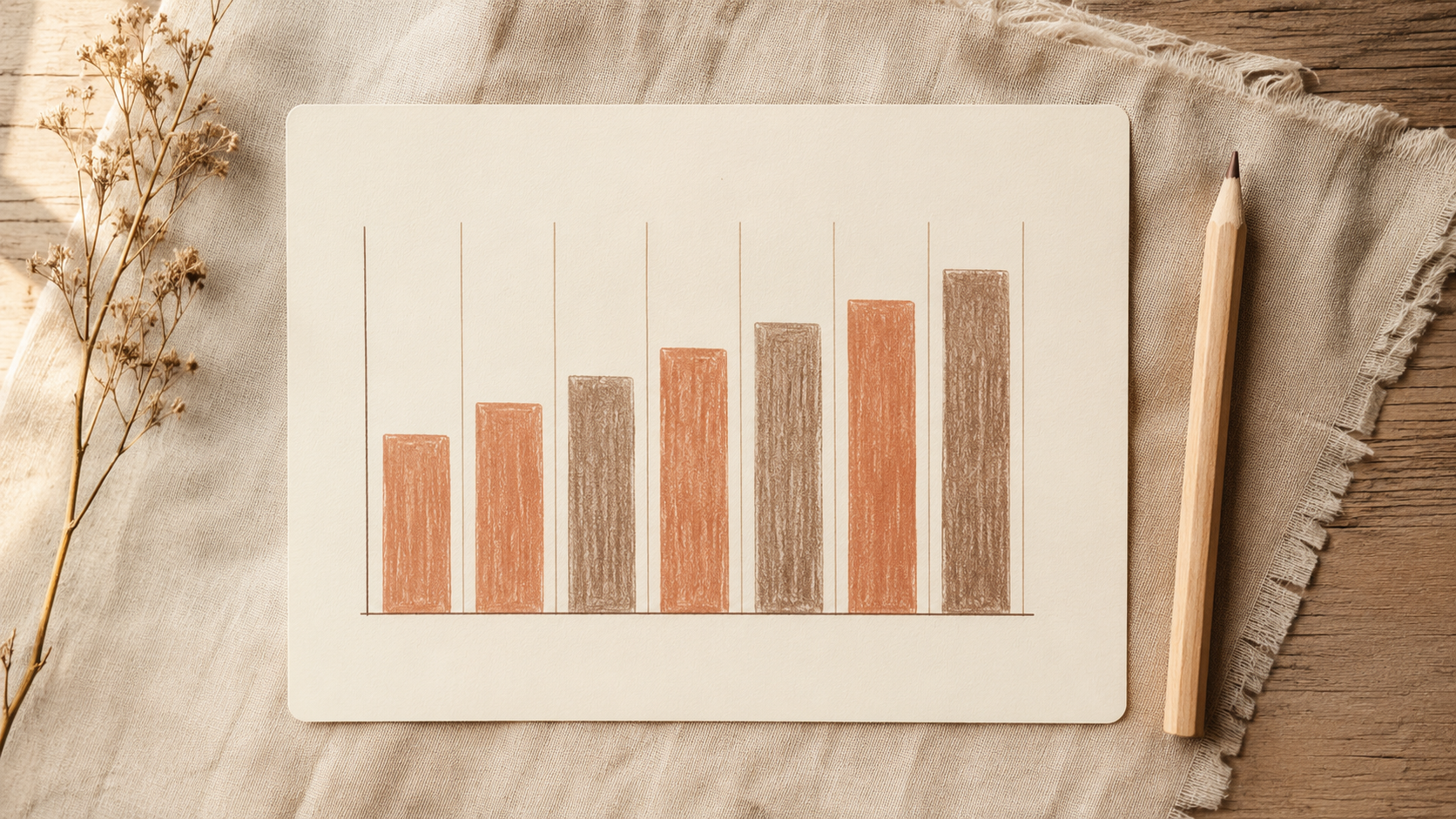
A motivational graph is a visual progress tracker that shows a child their behavior trend over time — not just today's result, but whether they're improving. Instead of a grid of sticker spaces, it uses a bar chart or line graph where each column is a day or a week and the height represents how often the behavior happened. The child can see the trend at a glance.
That's what makes it different from a standard reward chart for kids. A sticker chart shows effort accumulating toward a goal. A motivational graph shows pattern — and for kids who've lost interest in sticker grids, that shift is often what gets them re-engaged.
What a motivational graph actually does
It answers a question most behavior charts don't: am I getting better?
A child staring at a sticker chart can see how many marks they've earned. A child looking at a motivational graph can see that they completed their morning routine 4 days last week and 6 days this week. Those two extra days are visible as a rising bar. Progress becomes concrete.
The format matters most for kids who are 7 or older and who've outgrown the novelty of stickers. For them, the evidence of improvement is more motivating than accumulating marks toward a reward they chose months ago.
Research from the American Academy of Pediatrics shows that children respond better to visual feedback when they can observe their own progress clearly. A graph format makes that comparison easier than a filled grid because the shape of improvement is visible, not just the total.
How it differs from a behavior chart for kids
A behavior chart for kids typically tracks whether a behavior happened — yes or no, sticker or blank — and accumulates marks toward a reward. The structure is cumulative.
A motivational graph tracks frequency and direction. Did the behavior happen more or less than it did last week? The structure is comparative.
Both are forms of behavior charting. The difference is what question the child can answer at a glance:
- Behavior chart: "I have 14 stickers. I need 20 for my reward."
- Motivational graph: "Last week I did this 3 times. This week I did it 5 times."
For behavior goals where consistency is the challenge — not just one-off compliance — the graph format gives kids a clearer picture of what steady effort looks like over time.
A printable behavior chart and a motivational graph can serve the same underlying purpose. Whether you use one or the other depends on the child's age, the behavior you're tracking, and whether the child is more motivated by accumulation or by visible trend.
An incentive chart sits somewhere in between — it tracks specific behaviors toward a child-chosen reward. A motivational graph doesn't promise a reward; it just makes the data visible. For some kids, the trend itself becomes the reward.
When it works — and when it doesn't
A motivational graph works when:
- The child is 7 or older and can understand what a rising or falling bar means
- The behavior happens daily or near-daily, so there's enough data to show a weekly trend
- Consistency is the real goal, not a one-time compliance win
- The child is results-oriented and finds visible proof of improvement motivating
- You need a behavior tracking sheet that doesn't require a new printable every time a sticker grid fills up
It doesn't work when:
- The child is under 6 and doesn't yet grasp what a rising bar means
- The behavior is too infrequent to show a trend — once-a-week tasks produce flat graphs
- The child needs a tangible reward to stay motivated — the graph shows progress but doesn't promise anything at the end
- The parent doesn't have a reliable way to record data consistently
For children with ADHD, motivational graphs can work well if the feedback loop is tight. Same-day scoring, small intervals, and updating the graph immediately after the behavior is recorded are more important than the chart design itself. Delayed feedback loses its pull quickly for kids whose reward processing is harder to sustain. A CDC guide on positive reinforcement notes that the timing of feedback matters as much as its form — something worth keeping in mind when deciding how often to update the graph.
How to build a motivational graph: four steps
1. Pick one to two behaviors
The same rule applies here as with any behavior charting tool: specific and observable. "Uses an indoor voice at the dinner table" qualifies. "Is respectful" does not. One behavior for the first graph. Add a second only after the first has stabilized.
2. Decide what you're counting
A motivational graph needs a number, not just a check. Decide what you're recording: how many times the behavior happened per day, a 1–5 score for how well it went, or minutes if you're tracking something time-based like reading or focused work. Write the unit on the graph before week one starts — changing the scale mid-run makes the trend unreadable.
3. Set the time frame
Daily columns work for behaviors that happen every day. Weekly totals work for behaviors that happen multiple times a week but not predictably every day. Don't track a once-a-week behavior on a daily graph — you'll get a mostly-empty chart, and a child who looks at it will assume they're failing.
4. Show the child how to read it after week one
Sit down with the chart. Point at the bar. "Last week you did this four times. Let's see if we can get to five this week." Keep it short. The graph does most of the work. Your job is to make sure the child understands what the direction of the bars means — not to turn every check-in into a conversation about behavior.
Motivational graphs for kindergartners vs. older kids
For kindergartners (5–6), a motivational graph is usually too abstract. The bar chart format requires understanding that height represents quantity — a concept most 5-year-olds don't have reliably yet. A sticker chart printable or a visual routine chart works better at this age, and there's no reason to push the graph format before the child is ready for it.
A kindergarten behavior chart should stay visual, simple, and reward-adjacent. Stickers, checkboxes, smiley faces — concrete, immediate, and easy to fill in. The motivational graph pays off later, after the sticker novelty has worn off and the child is old enough to interpret trend data.
For 7–8 year olds, a simple bar graph with one behavior and daily columns works well. Keep the scale small: 0 to 5, not 0 to 10. Make sure the bars are thick and easy to color in — the act of filling in the bar is part of the feedback loop.
For kids 9 and older, a line graph is an option. Two behaviors on the same graph is manageable at this age. They can start recording the graph themselves, which adds another layer of ownership and removes one task from the parent's plate.
When to switch to a responsibility chart
A responsibility chart is a different tool for a different purpose. It's not tracking a single target behavior — it's showing a full list of ongoing expectations for a child's age or household role. Think of it as the baseline, not the intervention.
If the goal is reinforcing good behavior during a specific period or building a skill that needs extra attention, a motivational graph or printable behavior chart works better. If the goal is establishing clear household expectations and making responsibilities explicit for everyone, a responsibility chart is the right tool.
Most families use both at some point. The responsibility chart sets the standard. The motivational graph — or an incentive chart — works on whatever specific behavior needs more focus right now.
Frequently asked questions
What is a motivational graph for kids?
A motivational graph is a visual chart — usually a bar or line graph — that shows a child their behavior data over time. Instead of accumulating marks toward a reward, the child can see whether they're improving week over week. It works best for kids 7 and older who've outgrown sticker-based tracking.
How is a motivational graph different from a behavior chart?
A behavior chart for kids typically tracks whether a behavior happened and builds toward a reward. A motivational graph tracks frequency or quality over time so the child can see a trend — not just how many marks they have, but whether they're doing better than last week. Both are behavior charting tools; the difference is what question they answer at a glance.
What age works best for a motivational graph?
7 and up, reliably. Kids need to understand what a bar or line graph represents before the format is useful. For children under 7, a sticker chart printable or visual routine chart works better. Some 6-year-olds can follow a simple bar format; most don't until 7.
What behaviors work best on a motivational graph?
Daily behaviors that happen — or should happen — multiple times per week: morning routine completion, homework start time, sibling interactions, or any goal where consistency matters more than a one-time result. Behaviors that occur too infrequently don't produce enough data to show a meaningful trend.
Can you use a motivational graph for kids with ADHD?
Yes, with adjustments. Keep the scoring interval short — daily is better than weekly. Update the graph immediately after the behavior is recorded, not at the end of the day. Use a simple 1–5 scale rather than a raw count. Same-day visual feedback is the most important feature for ADHD-related behavior charting.
Includes a behavior tracking sheet designed with ADHD-friendly intervals, a visual chore chart for ages 5–12, a morning/evening routine chart, and a reward chart — all in one printable system.
Get the printable →