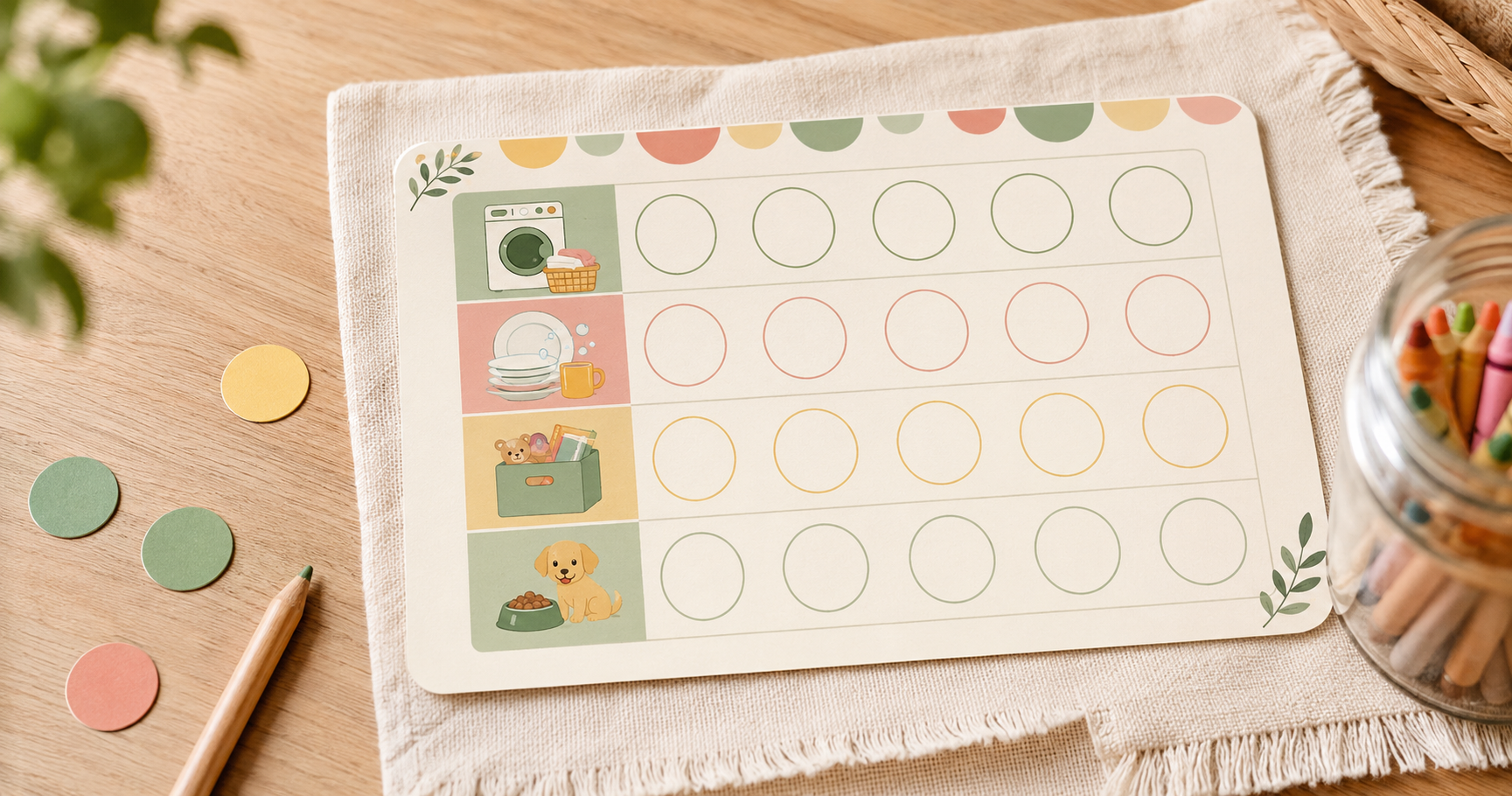
An ADHD chore chart works when it's built around how the ADHD brain actually processes tasks — not how a neurotypical planner assumes it does. That means shorter reward cycles, two or three chores instead of ten, visual reminders placed at the exact spot the task needs to happen, and clear one-step instructions that remove every possible point of ambiguity.
Standard chore charts fail kids with ADHD for predictable reasons. The child isn't lazy or defiant. The chart is designed for a working memory and executive function that ADHD children don't reliably have access to. The fix isn't more enforcement. It's a different design.
Why standard chore charts fail kids with ADHD
Most printable chore charts are built like a work schedule: a grid, a list of tasks, and checkboxes. That format works reasonably well for children who can hold a task in mind while doing something else, self-initiate when the time arrives, estimate how long something will take, and stay on track without external cues.
ADHD consistently affects all four of those abilities.
Working memory — holding a task in mind while doing something else — is one of the core areas of impairment in ADHD. A child can intend to clean their room, get distracted walking through the hallway, and genuinely forget the intention entirely. The chore chart on the kitchen fridge doesn't help if the child never sees it at the moment the task needs to happen.
Executive function — the ability to start, sequence, and complete a multi-step task — is the other major challenge. "Clean your room" means pick up clothes, make the bed, clear the desk, and put toys away. Each of those sub-steps requires its own initiation. Children with ADHD frequently get stuck after step one or two — not from unwillingness, but because re-initiating a task takes real cognitive effort every single time.
A chart designed without those realities in mind won't work no matter how well it looks on paper.
What the ADHD brain actually needs from a chore system
There is solid consensus across ADHD research — including at CHADD and in pediatric behavioral literature — on a few principles that reliably matter for ADHD behavior systems:
- Immediate feedback over delayed reward. An ADHD child can intellectually understand a reward coming on Friday. Emotionally, it's not motivating in the moment on Monday. Same-day rewards change behavior. End-of-week rewards often don't.
- External cues replace internal ones. Where a neurotypical child can hold a reminder internally, an ADHD child needs external prompts — a visible reminder at the right place and time, a physical timer, a check-in from a parent or caregiver.
- Task clarity over task quantity. "Put dirty clothes in the hamper" is one step and one decision. "Tidy your room" is neither. A task described in a single action is far easier to complete than one that requires interpretation.
- Repetition builds automaticity. The same two or three chores, at the same time, in the same way, for weeks on end — this is what eventually makes those tasks feel automatic rather than effortful.
None of this means ADHD children can't do chores. It means the chart itself needs to do the cognitive scaffolding that the ADHD brain struggles to do independently.
How to build an ADHD chore chart that actually holds
Use short reward cycles
For children under 10 with ADHD, daily rewards work better than weekly ones. A sticker earned at the end of each day — with a visible path to a small prize — keeps motivation active. Weekly reward charts often lose the child by Wednesday, because Wednesday is too far from last Friday's reward and too far from next Friday's.
For older children (10–14), a tiered points system can work — but only if there's a low-threshold first reward available within a few days. Don't design a chart where the first prize requires two weeks of perfect behavior.
Start with two or three chores
Not a list of eight. The goal in the first four to six weeks is building the habit, not completing the full household workload. Once two chores are running consistently for three weeks, add a third. Add a fourth after another three weeks. Every addition should feel achievable rather than like an escalating burden.
This mirrors the same principle behind effective behavior charts for kids broadly — the chart fails when the child can't win on most days.
Place the reminder at the point of action
The chart on the kitchen fridge doesn't help a child whose chores are in the bedroom. Tape a small reminder card inside the bedroom door. Post a hygiene checklist inside the bathroom cabinet. The reminder needs to appear at the exact location and moment the task needs to happen — not somewhere the child has to remember to check.
Anchor each chore to a specific time or event
ADHD time blindness is real. "Do it before dinner" is too vague to trigger action. "Do it when the 4:00 alarm goes off" gives the child a concrete external cue. "Right after you take off your shoes" pairs the chore to an existing habit. Specific time anchors remove the need for the child to remember to start.
Write tasks as single steps
"Make your bed" is one step. "Clean your room" is ten. Use single-action language for every item on the chart, even when the full job is more complex. If a chore genuinely involves multiple parts, create a separate sub-checklist posted near where the task happens — and keep the main chart clean.
Chores by age for kids with ADHD
Children with ADHD often function two to four years younger than their chronological age when it comes to executive function tasks. A nine-year-old with ADHD may need a chore structure closer to what you'd use for a six- or seven-year-old. That's a developmental difference that narrows over time — not a permanent ceiling.
| Age | Manageable chores | Notes |
|---|---|---|
| 4–6 | Put toys in a bin, bring plate to sink, put shoes by the door | Two tasks max. Daily reward. Model the task together first. |
| 6–8 | Make bed (loosely), set the table, feed a pet | No multi-step chores. Pair with a visual cue at the location. |
| 8–11 | Clear and wipe the table, take out small trash bags, put away folded laundry | Use a timer for each task. Three to four chores max per day. |
| 11–14 | Vacuum a room, load dishwasher, prep simple meals | Add one step at a time. Let the child set the schedule within limits. |
| 14+ | Cooking, yard work, grocery list, laundry start-to-finish | Negotiate rather than assign. Natural consequences carry more weight than charts at this age. |
The American Academy of Pediatrics recommends matching chore complexity to developmental readiness — not just age — and notes that consistent routines matter more than the specific tasks assigned.
The most common mistakes parents make
Tracking too many chores at once
A chart with ten items isn't motivating — it's overwhelming. When the child can't tell what matters most and fails often in the first week, the chart stops feeling winnable. Once it stops feeling winnable, the child stops trying.
A chart that gets completed 70–80% of the time is working. One that gets completed less than half the time needs to be simplified — not enforced harder.
Using punishment for forgotten chores
Punishing an ADHD child for forgetting a chore teaches them the system is unsafe — not that chores matter. Missing a chore should have a neutral outcome: the task still needs to happen, it just happens now. Adding a penalty on top of forgetting makes the ADHD child associate the chore chart with failure and punishment, which accelerates resistance.
Changing the chores too frequently
ADHD children need repetition to build automatic behaviors. Swapping the chores every two weeks removes the repetition before habits have a chance to form. Keep the same set for at least four to six weeks before rotating anything out.
Scrapping the chart after one bad week
One bad week is normal — especially around schedule disruptions, illness, or school transitions. Don't restart from zero or abandon the system. Reset the points if needed, re-walk through the expectations calmly, and continue. The chart only fails when you stop using it.
When a nanny or babysitter is part of the picture
An ADHD chore system only holds if everyone running the household follows it the same way. A babysitter who doesn't know the chart exists — or who isn't sure which tasks are assigned for that afternoon — can unintentionally undo three weeks of consistency in a single visit.
The chart rules need to be written down somewhere a caregiver can find without asking: what tasks are expected, what earns a mark, what the reward is, and what to do if a task is refused or forgotten. Verbal handoffs don't hold across shift changes.
If you use the same caregiver regularly, it's also worth having a five-minute conversation to confirm they understand the why behind the system — that this isn't optional good behavior, it's a therapeutic consistency tool that only works with repetition. Most caregivers are immediately on board once they understand that context.